Popular Post

Friday, October 31, 2025

Segmentation Fault (11): Deeper Core Dump of Pointer Secrets

Ahh ~

Hola, systems programmer. You've seen the tutorials that stop at int* p = &x;. That's the shallow end. We're going deep-sea diving into the memory map. Pointers are the fundamental abstraction that bridges your high-level logic with the raw, byte-addressable silicon of the machine. They are the source of your most arcane bugs—use-after-free, dangling pointers, buffer overflows—but they are also the only tool for true high-performance computing, custom data structures, and direct hardware manipulation. We're not just looking at the *, we're looking at the why. Forget the kiddie pool; this is the abyss.
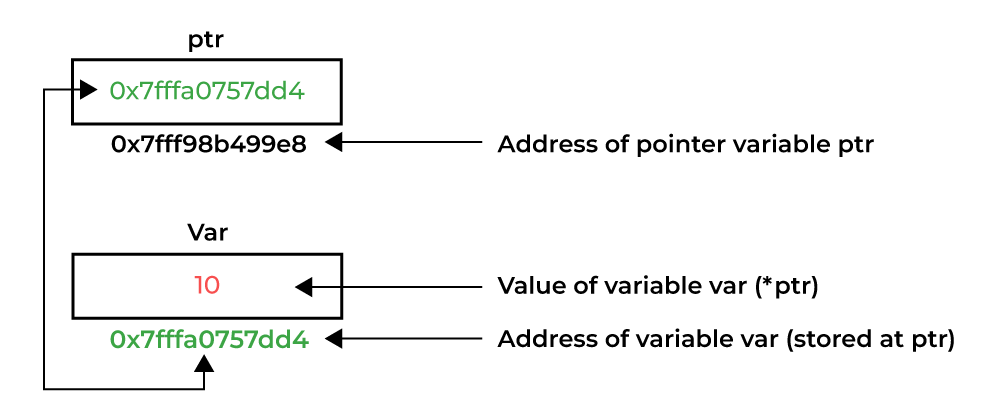
Image Source: GeeksForGeeks


Secret 1: Pointer Arithmetic is Scaled, Typed Arithmetic
The first trap for the uninitiated is to see p++ and think it means "add 1 to the address stored in p." This is fundamentally incorrect and misunderstands the core contract between the programmer and the compiler. Pointers are strongly typed for this very reason. The type of the pointer tells the compiler the size of the data it points to. All pointer arithmetic is automatically scaled by this size.

When you have int* p; on a 64-bit system where sizeof(int) is 4 bytes, the expression p++ is not translated to p = p + 1. The compiler translates it to p = (int*)((char*)p + sizeof(int)). If p was pointing to address 0x7FFF5FBFF8AC, after p++, it will point to 0x7FFF5FBFF8B0. If you had a MyStruct* s_ptr; where sizeof(MyStruct) is 32 bytes, s_ptr++ would advance the address by 32 bytes. This is the magic that makes array traversal possible. The clean, beautiful syntax arr[i] is nothing more than syntactic sugar for *(arr + i). The + i part of that expression is, in reality, a scaled offset calculation: address_of_arr + (i * sizeof(element_type)). This is why you can iterate over contiguous blocks of any data type with the same simple + operator.

Secret 2: The void* is the Type-Agnostic Primordial Ooze
The void*, or "generic pointer," is a special type that is just a raw address. It points to something, but the compiler has been explicitly told to forget what. It holds an address, but it has no associated type, and therefore no sizeof(). This makes it a powerful tool for C-style generic programming but also a dangerous one. You cannot dereference a void* directly (e.g., *my_void_ptr) because the compiler has no way to know how many bytes to read from that address: one (a char)? Four (an int)? A thousand (a struct)?

This is why malloc(1024) returns a void*. The heap allocator doesn't know or care what you plan to store in those 1,024 bytes. It just reserves the block and gives you the starting address. It is your responsibility to cast that void* to a concrete pointer type (e.g., int* my_array = (int*)malloc(100 * sizeof(int));) to inform the compiler of your intentions. This "imposes type" onto that raw memory. You also see void* used heavily in generic C library functions, most famously qsort. Its comparison function prototype is int (*compar)(const void *, const void *). It takes two generic pointers, and inside your custom comparison function, you must cast them back to your actual data type (e.g., const int* a = (const int*)p1;) to perform a meaningful comparison.

Secret 3: **p (Pointers-to-Pointers) are for "Pass-by-Reference" Emulation
This is the concept that melts brains, but it's built on a simple, iron-clad rule: C is always pass-by-value. When you pass a pointer int* p to a function, you are passing a copy of the pointer. That is, you are passing the address it holds, by value. The function gets its own local variable, a copy of that address. If you modify this local copy (e.g., p = (int*)malloc(...)), you are only changing the local copy. The caller's original pointer remains completely unchanged, leading to a classic memory leak and a NULL pointer on the caller's side.

So, how do you allow a function to change the caller's pointer? You must pass the address of the caller's pointer. And what is the type that holds the address of an int*? An int**. This is how C emulates "pass-by-reference" for out-parameters.

// Note the 'p_to_p' (pointer-to-pointer) argument
void actually_allocates(int** p_to_p) {
    // We dereference 'p_to_p' ONCE to get to the *original*
    // 'my_ptr' variable from the 'main' function's stack.
    // We are now modifying the caller's variable directly.
    *p_to_p = (int*)malloc(sizeof(int) * 10);
}

int main() {
    int* my_ptr = NULL;
    // We pass the address OF our pointer 'my_ptr'
    actually_allocates(&my_ptr);
    if (my_ptr != NULL) {
        my_ptr[0] = 5; // This works!
    }
    free(my_ptr);
    return 0;
}


This is precisely why main's argv is a char**. It's a pointer (*) to a list of other pointers (*), each of which points to the first char of a null-terminated string. It's an "array of strings" in C-speak.

Secret 4: Function Pointers Enable Runtime Polymorphism
Variables live in memory (stack, heap, data segment), and executable code for functions also lives in memory (in the read-only .text or code segment). If it lives in memory, it has an address. If it has an address, you can create a pointer to it. A function pointer stores the memory address of the start of a function's executable instructions. This allows you to treat functions as data: you can store them, pass them to other functions, and call them dynamically at runtime.

The syntax is notoriously "nerdy": return_type (*pointer_name)(argument_types);. For example, int (*op)(int, int); declares a pointer named op that can point to any function returning an int and taking two ints. This is the mechanism behind C-style callbacks. It's how you tell qsort which comparison function to use. But its most powerful use is in creating dispatch tables. Instead of a massive switch statement (which can be O(n) in a bad compiler), you can build an array of function pointers. An incoming command, cmd_id, can be used as a direct index into this array (dispatch_table[cmd_id]()) to call the correct handler in pure O(1) constant time. This is a foundational technique for building high-performance state machines, interpreters, and plug-in architectures.

Secret 5: The Modern C++ Secret is RAII (and No Raw Pointers)
After mastering all that complex, dangerous, raw pointer manipulation, the ultimate "nerdy" secret of modern C++ is to never do any of it. The C++ Core Guidelines are clear: do not use new and delete (and especially not malloc and free). Instead, you encapsulate resource ownership within objects that manage the resource's lifetime. This is the RAII (Resource Acquisition Is Initialization) idiom. The "resource" (like heap-allocated memory) is "acquired" in the object's constructor and "released" in its destructor.

This is what smart pointers () are.

std::unique_ptr: This is your default choice. It represents exclusive ownership of a resource. It's a lightweight wrapper that holds a raw pointer, but its destructor automatically calls delete on that pointer when the unique_ptr goes out of scope. This makes it impossible to leak the memory, even if an exception is thrown. It has zero-cost abstraction; it's the same performance as a raw pointer.

std::shared_ptr: This represents shared ownership. It maintains an internal "control block" with a reference counter. When you copy a shared_ptr, the count increments. When a shared_ptr is destroyed, the count decrements. When the count reaches zero, the last shared_ptr standing automatically deletes the resource.

std::weak_ptr: This is a non-owning companion to shared_ptr that breaks cyclical references. If two objects (e.g., Parent, Child) hold shared_ptrs to each other, their reference counts will never reach zero, and they will both leak. By making the Child's pointer to the Parent a std::weak_ptr, the child gets to observe the parent without contributing to its reference count, breaking the cycle.

Mastering raw C-style pointers teaches you how the machine works. Mastering smart C++ pointers teaches you how to build robust, safe, and maintainable systems on top of that machine.

Thursday, October 9, 2025

Apache Kafka: Distributed Event Streaming

(Keywords: Apache Kafka, distributed event streaming, publish-subscribe architecture, message broker, real-time data pipeline, stream processing, fault tolerance, horizontal scalability)

In the contemporary landscape of enterprise data engineering, one frequently encounters what can only be described as a deluge of information—a veritable tsunami of bytes cascading through computational infrastructure with relentless ferocity. Organizations operating in domains ranging from electronic commerce to financial services, from Internet of Things (IoT) sensor networks to social media platforms, generate data at rates that would make even the most seasoned database administrator's head spin faster than a magnetic disk platter (though admittedly, we've mostly moved to solid-state drives by now, haven't we?). The architectural challenge this presents is profound: without sophisticated mechanisms to orchestrate, buffer, and route these torrents of data, enterprises risk transforming their carefully designed systems into what one might charitably call "organized chaos" or, less charitably, "an absolute mess." Enter Apache Kafka—a distributed event streaming platform that, despite its literary namesake suggesting existential complexity, provides a remarkably elegant solution to the problem of real-time data movement at scale. While Kafka's capabilities span a spectrum of complexity that could intimidate the uninitiated, the foundational concepts underlying its architecture are, upon careful examination, surprisingly accessible to those willing to invest intellectual effort in comprehending its operational paradigm. This scholarly exposition endeavors to provide a comprehensive introduction to Apache Kafka's architectural principles, operational characteristics, and practical applications, delivered with sufficient rigor for academic discourse yet tempered with enough levity to prevent the onset of terminal ennui.

...

What Precisely Is Apache Kafka?

Apache Kafka represents a sophisticated implementation of a distributed, horizontally scalable, fault-tolerant commit log service optimized for the ingestion, storage, and distribution of streaming event data. To contextualize this technical definition through metaphorical reasoning (which, while frowned upon by purists, remains pedagogically effective), one might conceive of Kafka as the central nervous system of a modern data architecture—a critical intermediary through which information flows between disparate computational entities. In traditional software architectures, inter-application communication often adopts a point-to-point topology wherein each system maintains direct connections to every other system with which it must exchange data. This architectural pattern, while conceptually straightforward, scales poorly both from a complexity standpoint (connections grow exponentially as O(n²) with the number of systems) and from an operational maintenance perspective (each integration point represents a potential failure mode and requires bilateral coordination for modifications).

Image Source: behaimits.com

Kafka fundamentally reconfigures this paradigm by implementing a publish-subscribe messaging model mediated through a cluster of broker nodes that collectively manage persistent, ordered, and partitioned commit logs. Rather than establishing direct channels between data producers and consumers, applications interface exclusively with the Kafka cluster, publishing messages to named topics (logical channels organized by subject matter) and subscribing to topics of interest. This architectural decoupling yields several critical advantages: producers remain agnostic regarding the identity and quantity of downstream consumers; consumers can be added, removed, or modified without necessitating changes to producer logic; and the temporal coupling between data generation and consumption is eliminated, permitting asynchronous processing patterns. If one were to extend the postal system analogy introduced earlier (and why not? We're already committed to it), Kafka functions not merely as a mailbox but as an entire postal infrastructure complete with sorting facilities, delivery routes, and archival systems—except, mercifully, with considerably better delivery guarantees than certain real-world postal services and without the occupational hazard of canine encounters.

...

Deconstructing the Kafka Ecosystem

A comprehensive understanding of Apache Kafka necessitates familiarity with its constituent architectural elements and their interrelationships. At the highest level of abstraction, a Kafka deployment comprises four primary categories of entities: producers (applications that generate and publish event data), consumers (applications that subscribe to and process event streams), brokers (server processes that constitute the Kafka cluster and manage data persistence), and topics (logical partitions that organize events by category). However, this simplified taxonomy obscures considerable complexity that emerges upon deeper examination of Kafka's internal mechanisms.

Image Source: projectpro.io

Topics and Partitions: Topics represent the fundamental organizational unit within Kafka's data model—named categories to which producers publish messages and from which consumers retrieve them. While the topic abstraction provides a convenient logical grouping, the physical implementation employs a more granular structure called partitions. Each topic is subdivided into one or more partitions, where each partition constitutes an ordered, immutable sequence of records continually appended to a structured commit log. The partitioning mechanism serves multiple critical functions: it enables parallelism by distributing processing load across multiple consumer instances, facilitates horizontal scalability by allowing partition distribution across broker nodes, and provides the foundation for Kafka's ordering guarantees (messages within a single partition maintain strict ordering, though no cross-partition ordering is guaranteed). Messages are assigned to partitions through configurable strategies including round-robin distribution, hash-based key mapping, or custom partitioner logic, with the hash-based approach being particularly valuable for maintaining key-based ordering.

Producers: Producer clients bear responsibility for serializing application data, determining target partitions, and transmitting messages to the appropriate broker nodes. Modern Kafka producers implement sophisticated optimizations including batch aggregation (collecting multiple messages before transmission to amortize network overhead), compression (reducing bandwidth consumption and storage requirements through configurable compression codecs such as Snappy, LZ4, or ZSTD), and configurable acknowledgment semantics. The acknowledgment configuration, specified via the 'acks' parameter, governs durability guarantees: 'acks=0' provides no acknowledgment (fire-and-forget semantics with minimal latency but no delivery guarantees), 'acks=1' awaits acknowledgment from the partition leader (balanced approach suitable for many use cases), and 'acks=all' requires confirmation from all in-sync replicas (strongest durability guarantee at the cost of increased latency). Furthermore, producers can be configured as idempotent (via 'enable.idempotence=true') to eliminate duplicate message production within a producer session by assigning sequence numbers and producer IDs (PIDs) to each message, enabling brokers to detect and reject duplicate transmissions.

Consumers and Consumer Groups: Consumer clients subscribe to one or more topics and process the incoming message stream. Kafka's consumer group abstraction enables both load balancing and fault tolerance: multiple consumer instances can join a named consumer group, whereupon Kafka distributes topic partitions among the group members such that each partition is consumed by exactly one member at any given time. This design permits horizontal scaling of consumption capacity (adding consumers to a group increases parallel processing) while maintaining per-partition ordering guarantees. Consumer assignment strategies—including range assignment (distributes consecutive partitions to maximize partition co-location across topics), round-robin assignment (distributes individual partitions cyclically to maximize consumer utilization), and sticky assignment (minimizes partition movement during rebalancing to reduce disruption)—govern how partitions are allocated to consumers. Each consumer tracks its progress through a partition via offsets—monotonically increasing integer identifiers that represent position within the partition's message sequence—which are periodically committed to a special Kafka topic ('__consumer_offsets') to enable resumption after failures.

Brokers and Clusters: Kafka brokers are the server processes that collectively constitute the Kafka cluster, managing message persistence, serving client requests, and coordinating replication. Each broker stores a subset of topic partitions on local disk, with partitions distributed across the cluster to balance load and provide fault tolerance through replication. Partition replication, governed by a configurable replication factor, maintains multiple copies of each partition across different brokers. Among these replicas, one is elected as the leader (responsible for handling all read and write requests for that partition), while the remainder serve as followers (passively replicating the leader's log to maintain synchronization). Should a leader fail, one of the in-sync replicas (followers that have fully caught up with the leader's log) is automatically promoted to leadership, ensuring continuous availability. The coordination of this distributed system was historically managed by Apache ZooKeeper, an external consensus service, but recent Kafka versions have transitioned to KRaft (Kafka Raft), a native metadata management protocol that eliminates the ZooKeeper dependency and improves metadata operation latency and cluster recovery time.

Advanced Operational Mechanisms.................

The theoretical elegance of Kafka's architectural design would be of limited practical value without robust operational guarantees regarding message delivery, ordering, and durability. Distributed systems theory identifies three primary delivery semantics: at-most-once (messages may be lost but never duplicated), at-least-once (messages may be duplicated but never lost), and exactly-once (each message is delivered precisely once, the theoretical ideal). Kafka's configuration flexibility permits implementation of all three semantics depending on application requirements and willingness to accept latency trade-offs.

Achieving exactly-once semantics (EOS) in a distributed system presents formidable challenges, as it requires coordinating producer idempotence, transactional writes across multiple partitions, and consumer processing guarantees. Kafka addresses this through a combination of idempotent producers (which eliminate duplicates caused by producer retries through sequence numbering), transactional APIs (which enable atomic multi-partition writes that either commit completely or abort entirely), and consumer offset management within transactions (ensuring that processing and offset commits occur atomically). While the implementation details involve considerable complexity—including transaction coordinators, two-phase commit protocols, and transaction markers written to partition logs—the abstraction presented to application developers is remarkably clean: enable idempotence, wrap operations in transactional boundaries, and configure consumers to read only committed messages. Of course, these guarantees come with performance implications (EOS configurations exhibit higher latency than weaker consistency models), leading to the perennial distributed systems aphorism that one cannot simultaneously optimize for consistency, availability, and partition tolerance—though Kafka makes a rather admirable attempt at approaching that theoretical impossibility.

Another sophisticated operational mechanism deserving examination is Kafka's approach to log retention and compaction. By default, Kafka employs time-based retention policies (retaining messages for a configured duration, typically seven days, after which entire segments become eligible for deletion) or size-based policies (limiting partition size and removing oldest segments when thresholds are exceeded). However, for use cases requiring indefinite retention of the most recent state for each unique key—such as change data capture (CDC) pipelines, materialized view maintenance, or event-sourced systems—Kafka provides log compaction as an alternative retention strategy. Under compaction (enabled via 'log.cleanup.policy=compact'), Kafka periodically scans partitions and retains only the latest message for each unique message key, discarding older values. This mechanism ensures that the partition contains a complete snapshot of current state while controlling storage consumption, albeit at the cost of losing historical state transitions. Configuration parameters such as 'log.cleaner.min.cleanable.ratio' govern the aggressiveness of compaction, balancing between storage efficiency and the computational overhead of the cleaning process.

...

Stream Processing Paradigms

While Kafka's capabilities as a message broker and durable event log are substantial, its role as a foundation for stream processing applications represents an equally significant dimension of its utility. Stream processing—the computational paradigm concerned with continuous analysis and transformation of unbounded data sequences—has emerged as a critical requirement for applications demanding real-time insights, from fraud detection systems analyzing transaction patterns to recommendation engines adapting to evolving user behavior. Kafka's ecosystem includes Kafka Streams, a Java library providing stream processing capabilities that operate directly against Kafka topics without requiring separate processing cluster infrastructure.

Image Source: geeksforgeeks.org

Kafka Streams implements a functional programming model wherein developers compose streams (unbounded sequences of key-value pairs) and tables (changelog streams interpreted as point-in-time snapshots) through transformation operators including filtering, mapping, aggregating, joining, and windowing. The library handles complexities such as state management (maintaining processing state with fault-tolerant backing stores), exactly-once processing semantics (coordinating with Kafka's transactional mechanisms), and parallel execution (distributing stream processing tasks across multiple application instances). For users seeking even higher-level abstractions, ksqlDB provides a SQL interface atop Kafka Streams, enabling stream processing through declarative queries rather than imperative code. For instance, implementing fraud detection logic—filtering payment events where a probabilistic fraud score exceeds a threshold—requires a single SQL statement in ksqlDB, whereas the equivalent Kafka Streams implementation involves multiple lines of Scala or Java configuring topology builders, serializers, and state stores. The trade-off, naturally, is that ksqlDB's declarative approach sacrifices some flexibility compared to programmatic Kafka Streams development, though the ability to define user-defined functions (UDFs) in Java provides an escape hatch for custom logic.

Practical Applications? Apache Kafka's adoption spans industries and use cases with remarkable breadth, extending far beyond the cryptocurrency trading and high-frequency financial systems with which it is sometimes exclusively associated (though, admittedly, the ability to process millions of transactions per second does make it rather well-suited to those domains as well). Contemporary deployments leverage Kafka for diverse purposes including but not limited to the following representative scenarios:

  • Real-Time Data Pipelines: Organizations construct data pipelines using Kafka as the central nervous system, ingesting events from heterogeneous sources (application logs, database change streams, IoT sensors, user interactions) and routing them to various downstream systems (data warehouses, search indices, cache layers, machine learning models) with minimal latency. This architecture pattern, often termed the "lambda" or "kappa" architecture depending on whether batch and stream processing coexist or stream processing alone suffices, enables both real-time operational dashboards and historical analytical queries against the same underlying event stream. 
  • Event Sourcing and CQRS: Rather than persisting only current application state (as traditional create-read-update-delete architectures do), event-sourced systems store the complete sequence of state-changing events, from which current state can be derived through replay. Kafka's durable, ordered, and replayable commit logs align naturally with event sourcing requirements, while its partition model supports Command Query Responsibility Segregation (CQRS) patterns that separate write-optimized command models from read-optimized query models. 
  • Log Aggregation and Observability: Centralized log aggregation—collecting log streams from distributed application components, servers, and network devices into unified repositories for analysis—represents a foundational observability practice. Kafka serves as the transport layer in such architectures, buffering log events with guaranteed delivery before forwarding to analysis platforms (Elasticsearch, Splunk, time-series databases), thereby decoupling log producers from backend storage systems and providing backpressure resistance during processing bottlenecks. 
  • Microservices Communication Backbone: In microservices architectures, where monolithic applications decompose into suites of independently deployable services, asynchronous event-driven communication patterns often prove superior to synchronous request-response protocols. Kafka facilitates this through its publish-subscribe model, enabling services to emit domain events (e.g., "OrderPlaced," "InventoryUpdated," "PaymentProcessed") that other services consume and react to without tight coupling or distributed transaction complexity. 
  • Activity Tracking and Behavioral Analytics: Consumer-facing platforms such as social networks, content streaming services, and e-commerce sites generate torrents of user interaction events (page views, clicks, searches, purchases) that fuel recommendation engines, A/B testing frameworks, and business intelligence dashboards. Companies including LinkedIn and Netflix famously employ Kafka to capture these activity streams in real time, enabling personalization algorithms to adapt to evolving user preferences with minimal lag.

Practical Experimentation? Theoretical comprehension, while necessary, proves insufficient for developing genuine proficiency with distributed systems; hands-on experimentation remains the most effective pedagogical approach (though considerably more frustrating when things inevitably fail in inscrutable ways—debugging distributed systems having been accurately described as "trying to find a black cat in a dark room when there might not even be a cat"). For readers inclined toward practical exploration, the following progression provides a reasonable introductory trajectory:

  • Environment Setup: Begin by establishing a local Kafka installation, which has been considerably simplified with the advent of KRaft mode (eliminating the historical requirement to run ZooKeeper alongside Kafka). Download the latest Apache Kafka distribution, generate a cluster identifier using the provided storage tool, format the storage directories, and initiate a broker using the bundled KRaft configuration. Alternatively, containerized deployments using Docker Compose provide isolated environments with minimal host system configuration.
  • Basic Operations: Utilize Kafka's command-line interface tools to create topics with specified partition counts and replication factors, produce test messages using the console producer, and consume messages using the console consumer. Experiment with consumer groups by launching multiple consumer instances within the same group and observing partition assignment behavior, then contrast this with consumers in different groups (which receive independent copies of all messages).
  • Programmatic Interaction: Transition from command-line tools to programmatic clients by developing simple producer and consumer applications in Java, Python, or another supported language. Implement producers with various acknowledgment levels and observe the latency-durability trade-offs, configure idempotent producers and intentionally trigger retries to verify deduplication behavior, and experiment with consumer offset management (automatic versus manual commit strategies).
  • Stream Processing: Progress to stream processing by developing a Kafka Streams application that performs transformations on incoming event streams—perhaps computing aggregate statistics, joining related streams, or maintaining windowed computations. Alternatively, explore ksqlDB's SQL interface for stream processing without Java development.

...

Common Antipatterns and Operational Best Practices

As with any sophisticated distributed system, Kafka deployment and operation present numerous opportunities for suboptimal configuration choices that degrade performance, compromise reliability, or complicate maintenance (the cynic might observe that distributed systems seem specifically designed to maximize the surface area for operational mistakes, though the optimist would counter that this merely reflects the inherent complexity of coordinating computation across unreliable networks—both perspectives contain elements of truth). Awareness of common antipatterns and adherence to established best practices significantly improves operational outcomes:

Message Size Considerations: While Kafka theoretically supports messages up to the broker's 'message.max.bytes' configuration (default 1MB, though configurable), performance characteristics degrade substantially with large messages due to increased memory consumption, network saturation, and reduced batching effectiveness. For large payloads (multimedia files, substantial documents, large JSON structures), consider storing actual content in object storage (S3, Azure Blob Storage) and publishing only metadata references to Kafka topics.

Consumer Lag Monitoring: Consumer lag—the delta between the latest offset produced to a partition and the offset most recently consumed by a consumer group—represents a critical operational metric indicating whether consumers maintain pace with producers. Persistent or growing lag suggests insufficient consumer capacity, inefficient processing logic, or downstream bottlenecks requiring remediation through consumer scaling, code optimization, or architectural redesign.

Partition Count Planning: Determining appropriate partition counts involves balancing parallelism opportunities (more partitions enable more consumers) against coordination overhead and latency implications (excessive partitions increase metadata volume and end-to-end latency). General guidance suggests sizing partition counts to accommodate anticipated peak consumer parallelism while avoiding extreme values (single-partition topics forfeit parallel processing; thousand-partition topics incur substantial overhead).

Replication Configuration: Operating Kafka clusters without replication (replication factor of one) eliminates fault tolerance, rendering any broker failure a data loss event. Production deployments should employ replication factors of at least three, combined with appropriate 'min.insync.replicas' settings to ensure that writes are acknowledged only after propagation to multiple replicas.

Schema Management: In the absence of enforced schemas, producers and consumers operating on shared topics risk data format incompatibilities (the classic "I expected JSON but received Avro" scenario, or worse, "I expected JSON with these fields but received JSON with different fields"). Schema registries (such as Confluent Schema Registry) enforce schema contracts, enable schema evolution with compatibility guarantees, and reduce serialization overhead through schema ID references rather than inline schema transmission.

...

Streaming Future-

Apache Kafka, despite initial appearances of daunting complexity, reveals itself upon systematic study as a coherent, elegantly architected distributed system addressing fundamental challenges in modern data infrastructure: how to reliably move, store, and process continuous streams of events at massive scale with acceptable latency characteristics and robust durability guarantees. The architectural patterns it embodies—publish-subscribe messaging, distributed commit logs, horizontal scalability through partitioning, fault tolerance through replication, and stream processing as a first-class concern—have proven sufficiently valuable that numerous organizations now consider Kafka infrastructure as foundational as database management systems or load balancers. 

For practitioners navigating the contemporary data landscape, where the volume, velocity, and variety of information continue their inexorable expansion (leading to the somewhat tired but nonetheless accurate "big data" characterization that we're all somewhat embarrassed to still reference), proficiency with streaming platforms represents an increasingly essential competency. Whether the objective involves constructing real-time analytics pipelines that surface insights while events remain actionable, implementing event-driven microservices that scale elastically while maintaining loose coupling, or simply gaining appreciation for the engineering sophistication underlying systems handling billions of daily events, Kafka provides both practical capability and intellectual enrichment.

The platform's evolution continues with ongoing enhancements addressing limitations in the current architecture—KRaft's elimination of ZooKeeper dependency, tiered storage support enabling cost-effective historical retention, and ecosystem expansion encompassing connectors, stream processors, and operational tooling. In an era where data has been somewhat hyperbolically but not entirely inaccurately described as "the new oil" (though unlike petroleum, data's value appreciates rather than depletes through use, and its environmental impact remains primarily limited to data center electricity consumption rather than atmospheric carbon), Kafka functions as critical refinery infrastructure—ingesting raw event streams, transforming them through processing pipelines, and distributing refined information products to consuming applications. Mastery of its fundamentals, while demanding initial investment in understanding distributed systems concepts, unlocks access to architectural patterns and operational capabilities that define contemporary data engineering practice.

Recommended Resources for Continued Study:

For readers seeking to deepen their understanding beyond this introductory treatment, the following resources provide pathways for continued learning at varying levels of technical depth and pedagogical approach:

  • Apache Kafka Official Documentation: The authoritative reference for architectural details, configuration parameters, API specifications, and operational guidance, maintained by the core development community.
  • Confluent Developer Resources: Comprehensive tutorials, sample projects, architectural patterns, and video courses provided by Confluent, the commercial entity founded by Kafka's original creators.
  • "Kafka: The Definitive Guide" (O'Reilly): Authored by Neha Narkhede, Gwen Shapira, and Todd Palino, this text provides exhaustive coverage of Kafka's architecture, operational considerations, and ecosystem components suitable for practitioners requiring production deployment expertise.
  • Online Course Platforms: Structured learning paths available through Udemy, Coursera, and Pluralsight offering guided instruction with hands-on exercises for learners preferring interactive pedagogical formats.
  • Technical Blogs and Community Forums: Ongoing discussions of operational experiences, performance tuning techniques, and architectural patterns shared through platforms including the Confluent blog, Stack Overflow, and the Apache Kafka mailing lists.

The journey from conceptual understanding to operational proficiency with distributed systems invariably involves encountering frustrating debugging sessions (mysterious consumer rebalancing behavior, inscrutable ZooKeeper connection timeouts that turned out to be network misconfigurations, and the eternal question of "why is this partition's ISR shrinking?"), but the capability to architect and operate systems processing millions of events per second with sub-second latency provides ample compensation for the occasional three-a.m. production incident. Welcome to the streaming data infrastructure community—may your throughput be high, your latency low, and your replication factors always greater than one.

...

Drop your thoughts in the comments below! Let’s swap war stories and learn from each other. Connect with me:

Tuesday, October 7, 2025

Blueprint to Deployment: End-to-End Automation with Terraform, Kubernetes, and CI/CD

(Keywords: DevOps, Infrastructure as Code, IaC, Automation, Cloud, Kubernetes, Terraform, Ansible, CI/CD, Monitoring, Observability)

Let’s be honest — the world of software development can sometimes feel like a chaotic ballet performed by caffeinated squirrels. Ideas fly fast, creativity runs wild, and then suddenly… everything slows to a crawl. Deployments become manual marathons, servers break without warning, and the classic “it works on my machine” makes its tragic return.

That’s where DevOps infrastructure swoops in — not wearing a cape, but carrying a toolkit of automation, orchestration, and clever engineering practices that bring harmony to the madness. It’s about turning the unpredictable art of software delivery into a predictable science. Think of it as building sturdy bridges between development (Dev) and operations (Ops), ensuring that brilliant ideas reach users faster, safer, and with far fewer caffeine-fueled all-nighters.

And no, this isn’t about trendy buzzwords or shiny new frameworks. It’s about a fundamental shift — a cultural and technical evolution that changes how we build, test, deploy, monitor, and scale software. Done right, it’s nothing short of transformational. Done wrong, well... you’ll be drowning in YAML files and Terraform state conflicts before lunch.

...

What Exactly Is DevOps Infrastructure?

The term “DevOps” gets thrown around like confetti at a tech conference. But when we zoom in on the infrastructure side of DevOps, that’s where the real magic happens.

DevOps Infrastructure is the collection of practices, tools, and philosophies that automate everything from server provisioning to application deployment, network configuration, and security enforcement.

It’s about treating infrastructure as software — managing your servers, networks, and cloud resources using code, just like your app itself. Instead of manually configuring environments (which is about as fun as assembling IKEA furniture blindfolded), we use Infrastructure as Code (IaC) to define everything in scripts or declarative templates.

This shift brings predictability, repeatability, and version control — the holy trinity of modern operations. You can spin up entire environments with a single command, tear them down just as easily, and ensure every stage — from dev to production — runs in sync.

DevOps Image Source: nexinfo.com
Image Source: nexinfo.com

Key Components of DevOps Infrastructure -

Let’s unpack what makes a solid DevOps infrastructure tick.

1. Automation Is King

If you’re still manually creating VMs at 3 AM, you’re living in the past. Automation eliminates repetitive work, reduces human error, and frees engineers to focus on innovation. Scripts and tools take care of everything — provisioning servers, configuring systems, deploying apps, even scaling them when traffic surges.

Automation isn’t just a productivity boost; it’s a reliability guarantee. It means your infrastructure behaves the same way every single time you deploy it.

2. Version Control (Git, etc.)

Every piece of your infrastructure code lives in a repository, right beside your application code. This isn’t optional — it’s essential. Version control enables collaboration, rollbacks, and a clear audit trail. If something breaks, you can pinpoint exactly what changed and when.

Bonus: Code reviews now extend to your infrastructure too, helping catch misconfigurations before they go live.

3. Continuous Integration / Continuous Delivery (CI/CD)

CI/CD automates the entire software delivery pipeline — from code commit to production deployment. It replaces manual checklists with a seamless, repeatable flow of testing, building, and shipping.

No more nerve-wracking, late-night “push to prod” sessions powered by cold pizza and sheer willpower. With CI/CD, deployments become routine — fast, reliable, and reversible.

4. Cloud Computing

Platforms like AWS, Azure, and Google Cloud have changed the game. They provide on-demand, scalable infrastructure that fits perfectly with DevOps automation. But it’s not just about “moving to the cloud” — it’s about leveraging cloud-native design, where infrastructure is elastic, ephemeral, and programmable.

And for the record, IaC principles apply anywhere — whether your servers live in AWS, your data center, or a Raspberry Pi cluster under your desk.

5. Containerization (Docker)

Containers solve the “works on my machine” nightmare. By packaging applications with all their dependencies, Docker ensures consistency across development, testing, and production. Developers can focus on coding without worrying about mismatched environments.

6. Orchestration (Kubernetes)

Once you have containers, you need someone to keep them in check. That’s where Kubernetes comes in — the all-powerful conductor of your microservices orchestra. It automates deployment, scaling, and management, ensuring every component plays its part without missing a beat.

...

The IaC Toolkit

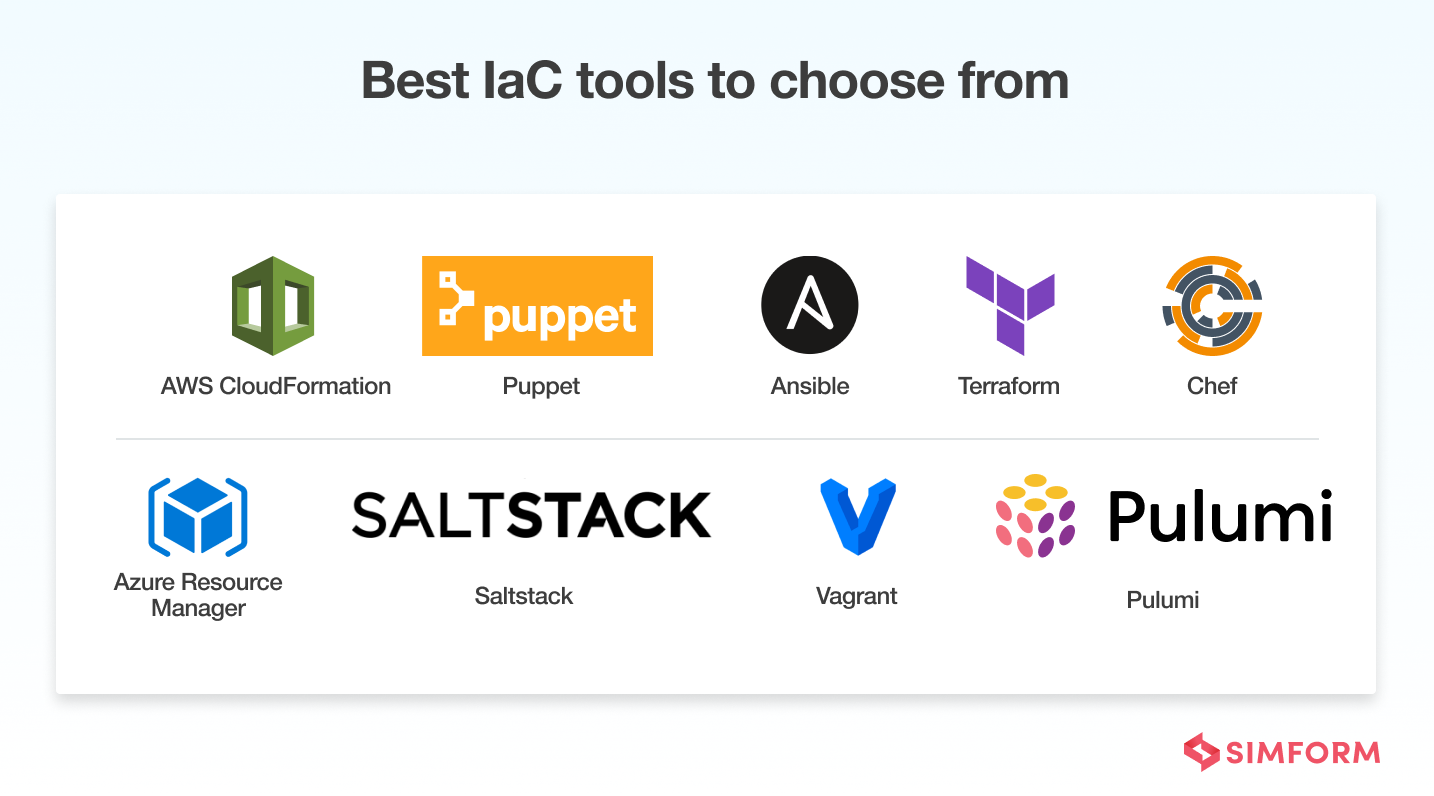
So, what tools bring all this to life? Let’s meet the rockstars of the IaC world:

IaC ToolKit Image Source: simform.com
Image Source: simform.com

Terraform:

The undisputed champion of infrastructure automation. Terraform lets you define your infrastructure using a declarative language called HCL (HashiCorp Configuration Language). It supports multi-cloud environments and can manage everything — from VMs to databases to DNS zones.

Pro tip: Think of Terraform as the architect designing your digital city — it plans every building, road, and traffic light before breaking ground.

Ansible:

Where Terraform is the architect, Ansible is the hands-on craftsman. It automates configuration management, application deployment, and routine tasks using simple YAML playbooks. It’s perfect for provisioning servers or ensuring they stay in a consistent state.

Humorous aside: If Terraform designs the city, Ansible is the tireless handyman fixing everything from the light bulbs to the plumbing.

CloudFormation / ARM / Deployment Manager:

Every cloud provider offers its own IaC flavor — AWS CloudFormation, Azure Resource Manager, Google Cloud Deployment Manager. These are great if you’re fully committed to one cloud. But for multi-cloud flexibility, Terraform still reigns supreme.

...

Importance of Observability (Because Things Will Go Wrong).........................

Even the most elegant infrastructure will stumble at times. That’s why observability is so critical — it’s your window into the soul of your system. Without it, debugging issues is like trying to find a needle in a haystack… during a thunderstorm.

The Three Pillars of Observability:

  • Metrics: Quantitative data like CPU usage, memory consumption, and response times.

  • Logs: The raw text of what actually happened — invaluable for diagnosing issues.

  • Traces: End-to-end visibility into how requests move through your system. Perfect for spotting latency and bottlenecks.

Tools like Prometheus, Grafana, Elasticsearch, and Jaeger help you collect, visualize, and interpret this data, giving you real-time insight into system health and performance.

...

Practical Example: Building a Scalable Web Application Using Terraform and Kubernetes

Let’s imagine a real-world scenario. You’re part of a growing startup, and your team has just built a slick new web application — the next big thing. It’s running perfectly on your local machines, but now comes the real test: deploying it to the cloud in a way that’s reliable, scalable, and automated.

Traditionally, this might have meant manually spinning up servers, configuring load balancers, copying application files, and praying nothing breaks in the process. But in the DevOps world, we replace that stress with code-driven automation. Here’s how it plays out when we combine Terraform and Kubernetes — two powerhouses that make infrastructure and deployment dance together seamlessly.


Step 1: Define the Infrastructure with Terraform

We start with Terraform, the architect of our digital environment. Instead of clicking through cloud dashboards, we define every component — virtual machines, networks, storage, and load balancers — using Terraform configuration files written in HCL (HashiCorp Configuration Language).

For example, you might write a Terraform file that defines an AWS VPC (Virtual Private Cloud), a few EC2 instances, and a load balancer to distribute traffic. Here’s a simplified conceptual snippet:

resource "aws_instance" "web_server" {
ami = "ami-123456"
instance_type = "t3.micro"
tags = {
Name = "devops-demo-server"
}
}

When you run terraform apply, Terraform connects to your cloud provider’s API and provisions everything automatically — no manual setup required. The configuration becomes a blueprint for your infrastructure, which means you can recreate it anywhere, anytime, in the exact same way.

The beauty of this approach: your infrastructure is now version-controlled, documented, and repeatable. If a server crashes or you need to replicate your environment for testing, you simply re-run your Terraform scripts — and voilĂ , a fresh setup appears.


Step 2: Deploy Kubernetes on Top

Once the infrastructure is up, it’s time to bring in Kubernetes, the maestro of container orchestration. Kubernetes takes your application, which you’ve packaged into Docker containers, and manages everything from deployment to scaling to recovery.

Terraform can even provision a Kubernetes cluster for you — whether on AWS EKS, Google GKE, or Azure AKS. After the cluster is up, you define your application deployment using Kubernetes manifests (YAML files).

For instance, your deployment file might look something like this:

apiVersion: apps/v1
kind: Deployment
metadata:
name: web-app
spec:
replicas: 3
selector:
matchLabels:
app: web-app
template:
metadata:
labels:
app: web-app
spec:
containers:
- name: web-container
image: myapp:v1
ports:
- containerPort: 80

This tells Kubernetes: “Hey, I need three replicas of this container running at all times.” Kubernetes ensures that’s always true — if one pod dies, it automatically spins up another. It’s like having an ever-vigilant system administrator who never sleeps.


Step 3: Automate Deployment and Scaling

Now that your app is live in the cluster, you can introduce automation pipelines to make deployments effortless. Tools like Jenkins, GitHub Actions, or GitLab CI/CD can be configured to trigger a new deployment whenever you push code changes.

When a developer merges a pull request, the CI/CD pipeline builds a new Docker image, pushes it to a registry (like Docker Hub or Amazon ECR), and updates the Kubernetes deployment — all automatically. Terraform ensures the underlying infrastructure is consistent, while Kubernetes ensures your application is running smoothly on top of it.

And because Kubernetes supports auto-scaling, your web app can respond dynamically to traffic spikes. If your app suddenly goes viral and a flood of users hits your servers, Kubernetes can scale up additional pods to handle the load — then gracefully scale back down when traffic normalizes. That’s the essence of modern scalability.


Step 4: Implement Monitoring and Observability

Once your system is humming along, the next essential step is observability. Even the best setup needs visibility to ensure everything’s healthy.

You can integrate tools like Prometheus and Grafana for metrics, Elasticsearch and Kibana for logs, and Jaeger for tracing requests through microservices. Terraform can even automate the setup of these observability components — ensuring they’re deployed and configured right alongside your infrastructure.

Imagine having a Grafana dashboard showing real-time CPU usage, network traffic, and application latency. If something goes wrong, you can pinpoint the problem in seconds instead of sifting through endless log files.


Step 5: Tear Down and Rebuild (Because You Can)

Here’s where Infrastructure as Code really shines. When your testing or development environment is no longer needed, you can simply run terraform destroy — and the entire stack (VMs, load balancers, security groups, everything) is safely torn down.

Need to replicate that same environment for another project or region? Just rerun the same Terraform scripts. It’s like having a “save game” button for your infrastructure.


Why This Workflow Matters??????????

This Terraform + Kubernetes combo isn’t just about convenience — it’s about control, consistency, and confidence. You gain the ability to:

  • Reproduce complex environments instantly.
  • Avoid configuration drift (where servers slowly become inconsistent).
  • Scale effortlessly as user demand grows.
  • Recover quickly from failures with minimal downtime.
  • Keep developers and ops in sync through code, not guesswork.
It’s the difference between juggling servers and conducting a well-tuned orchestra.

Common Pitfalls (and How to Dodge Them Like a Pro) -

Even with great tools, things can go sideways. Here are a few traps to avoid:

  • Over-Engineering: Don’t build a spaceship when you just need a car. Start small, test, and scale gradually.
  • Neglecting Version Control: Infrastructure without Git is like driving blindfolded — you’ll crash eventually.
  • Ignoring Security: Automate security from day one. Enforce least privilege, encrypt sensitive data, and scan regularly.
  • Skipping Documentation: Automation is wonderful, but humans still need to understand what’s going on. Write it down.

...

Ready to Take the Leap?

DevOps infrastructure isn’t a one-time project — it’s an evolving practice. It’s about continuous learning, experimentation, and collaboration across teams.

The payoff? Faster releases, fewer outages, more sleep, and happier developers. You’ll spend less time firefighting and more time building cool things.

If you’re ready to dive deeper, check out these must-read resources:

Your Turn: What’s been your biggest challenge in managing infrastructure — automation, scaling, or maybe wrangling YAML files that refuse to behave? Drop your thoughts in the comments below! Let’s swap war stories and learn from each other. Connect with me:

Featured Post

Segmentation Fault (11): Deeper Core Dump of Pointer Secrets

Ahh ~ Hola, systems programmer. You've seen the tutorials that stop at int* p = &x; . That's the shallow end. We're going d...